
Understanding the Order of Communication Development in Children
Why development does not start with speech
When parents are concerned about communication, the focus is often on speech.
However, speech is only one part of communication, and it develops last.
Children build communication skills in a sequence. Each stage supports the next.
If one area is still developing, it can have an impact on everything that follows.
The five key areas of development
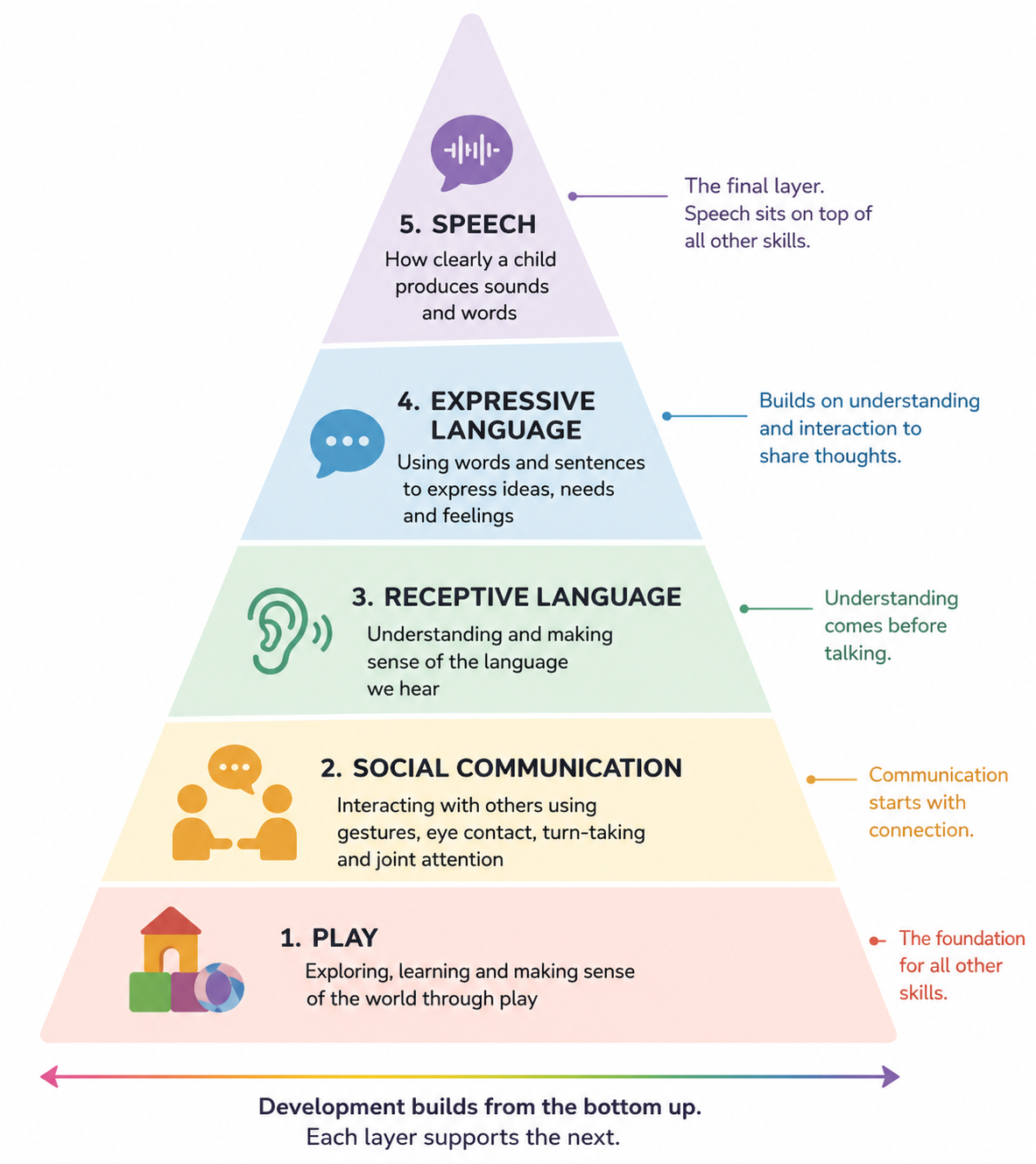
Communication development can be understood in five main areas:
Play
Social communication
Receptive language (understanding)
Expressive language (talking)
Speech (sounds)
These areas develop in a general order, although there is always some overlap.
1. Play
Play is the foundation of communication.
Before children use words, they learn through interacting with objects and people.
This includes:
exploring toys (e.g. banging, shaking, mouthing)
understanding cause and effect (e.g. pressing a button to make something happen)
using toys appropriately (e.g. rolling a car, stacking blocks)
pretend play (e.g. feeding a doll, making toys “sleep”)
What this looks like in everyday life
A child with developing play skills will:
show interest in toys
use toys in a purposeful way
begin to use imagination in play
A child who may be finding this area difficult might:
have limited interest in toys
repeat the same actions without variation
find it difficult to use toys meaningfully
Why play matters
Play supports attention, learning, and understanding.
These are essential for later communication and language development.
2. Social communication
Once children are engaged with the world, they begin to share that experience with others.
This is sometimes called interaction or early communication.
This includes:
eye contact
responding to their name
taking turns
using gestures (e.g. pointing, waving)
joint attention (sharing focus on the same object or activity)
What this looks like in everyday life
A child with developing social communication will:
look towards people
share enjoyment
initiate interaction
respond to others
A child who may be finding this area difficult might:
prefer to play alone
not consistently respond to their name
find it difficult to take turns
use fewer gestures
Why social communication matters
Communication is about connection, not just words.
These early skills form the basis for meaningful interaction and language use.
3. Receptive language (understanding)
Children understand language before they use it.
Receptive language refers to how a child processes and understands what is said to them.
This includes:
understanding words
following instructions
identifying objects and people
understanding simple concepts (e.g. in, on, big, small)
What this looks like in everyday life
A child with well-developed understanding will:
follow instructions appropriate for their age
respond to familiar words
show understanding through actions
A child who may be finding this area difficult might:
struggle to follow instructions
rely heavily on visual cues
appear not to understand what is said
Why understanding matters
A child needs to understand language before they can use it.
Difficulties with understanding often affect expressive language development.
4. Expressive language (talking)
Expressive language is a child’s ability to use words and sentences.
This develops gradually over time.
This includes:
using single words
combining words
building sentences
asking and answering questions
sharing ideas and experiences
What this looks like in everyday life
A child with developing expressive language will:
use words appropriate for their age
combine words into phrases and sentences
communicate their needs and ideas
A child who may be finding this area difficult might:
use fewer words than expected
struggle to combine words
find it difficult to express ideas clearly
become frustrated when trying to communicate
Why expressive language matters
Expressive language allows a child to share their thoughts and engage with others.
It builds on play, interaction, and understanding.
5. Speech (sounds)
Speech refers to how clearly a child produces sounds and words.
This includes:
learning speech sounds
putting sounds together in words
being understood by others
What this looks like in everyday life
A child with developing speech skills will:
be increasingly understood as they get older
produce a range of speech sounds
A child who may be finding this area difficult might:
be difficult to understand
use simplified or unclear speech
Why speech matters
Speech clarity supports effective communication.
However, it sits on top of all other areas of development.
The developmental sequence
Communication skills tend to build in the following order:
play → social communication → understanding → talking → speech
This does not mean each stage is fully complete before the next begins.
However, earlier skills provide the foundation for later ones.
Why this matters
If a child is experiencing difficulties with speech or language, it is important to look at all areas of development.
For example:
a child with limited play skills may find it harder to develop language
a child who finds interaction difficult may not use language socially
a child with reduced understanding may struggle to express themselves
Focusing only on speech can overlook the underlying cause of the difficulty.
Important note on development
All development follows a general pattern, but children develop at different rates.
Skills are not always evenly developed across areas.
Assessment focuses on understanding a child’s overall communication profile, rather than comparing them to a single expectation.
Putting it all together
Communication development includes:
play
social communication
receptive language
expressive language
speech
Understanding how these areas connect provides a clearer picture of a child’s strengths and needs.
Final thought
Speech is what we hear, but communication starts much earlier.
Looking at the full developmental picture allows the right support to be put in place at the right time.
If you have concerns about any area of your child’s development, or you are unsure whether their skills are developing as expected, getting advice early can help you understand what is going on and what support may be helpful.