
Understanding Expressive Language in Children
What is expressive language?
Expressive language is a child’s ability to communicate their thoughts, ideas, and needs.
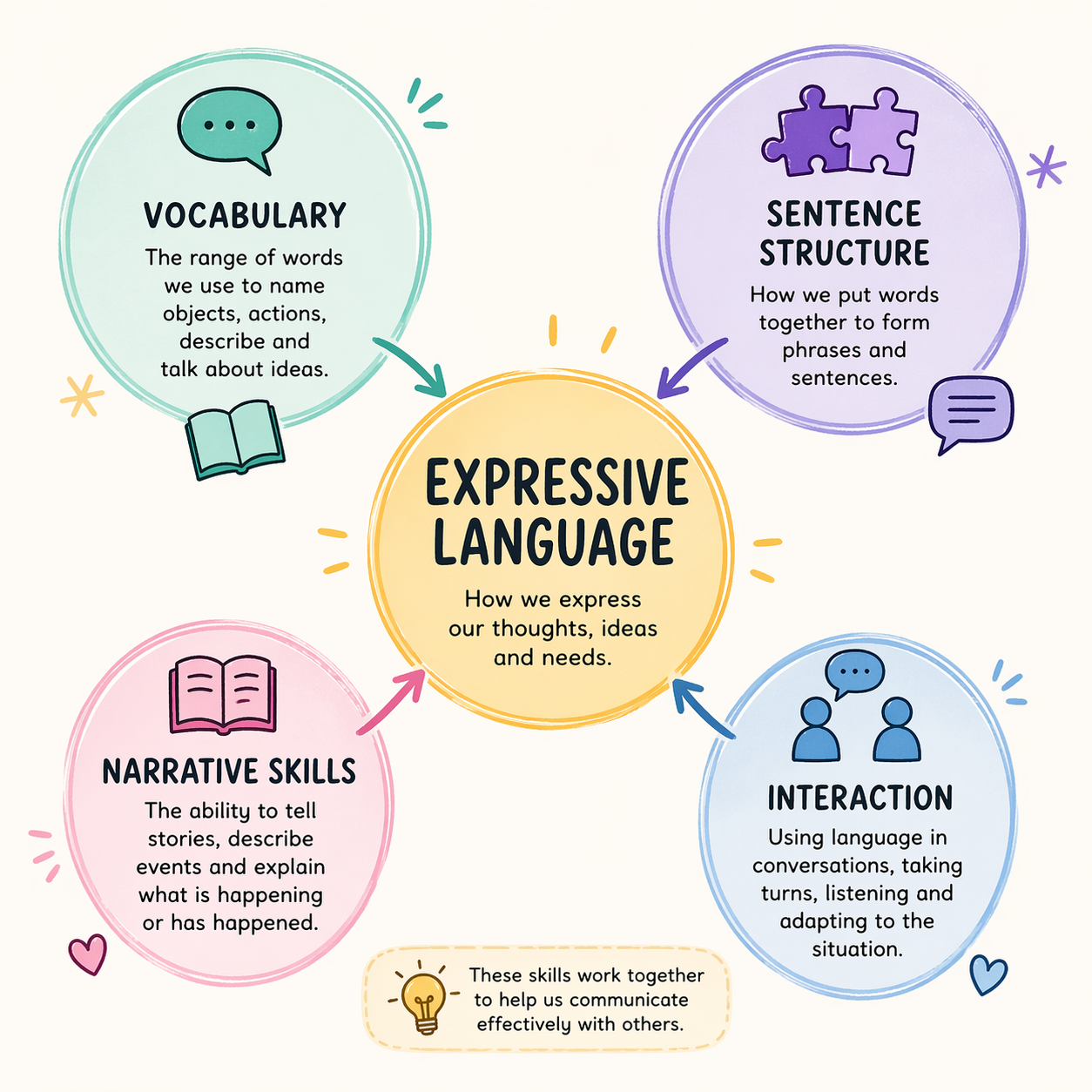
This includes:
putting words together
using words and sentences
asking and answering questions
telling stories
using language in conversation
It is how a child shares what they are thinking.
Children typically understand more than they can say, particularly in the early years.
What does expressive language look like in everyday life?
A child with well-developed expressive language will:
use words and sentences appropriate for their age
express their needs and ideas clearly
take part in conversations
ask questions and share experiences
A child with expressive language difficulties might:
use fewer words than expected
rely on gestures or pointing
struggle to put sentences together
find it hard to explain things
become frustrated when trying to communicate
Why expressive language matters
Expressive language skills contribute to:
communicating wants and needs
making friends and maintaining relationships
participating in learning
building confidence
regulating emotions
Difficulties with expressive language have been linked to later challenges in literacy, academic attainment, and social development.
How we assess expressive language
Expressive language is assessed by looking at how a child communicates across different situations, not just in structured tasks.
Key ways expressive language is assessed
1. Vocabulary (what a child can say)
This looks at the range of words a child uses, including:
objects (e.g. “car,” “dog”)
actions (e.g. “run,” “eat”)
describing words (e.g. “big,” “fast”)
Typical development (guideline ranges)
(Adapted from Fenson et al., 2007; RCSLT guidance)
By 12 months: may say a few recognisable words
By 18 months: around 10–20 words
By 2 years: around 50+ words, beginning to combine words
By 3 years: rapid vocabulary growth (often several hundred words)
By 4–5 years: several thousand words
There is natural variation, particularly in early vocabulary size.
2. Sentence structure (how words are put together)
This looks at how a child combines words into phrases and sentences.
Typical development
(Adapted from Owens, 2020)
Around 18–24 months: two-word combinations (e.g. “more juice”)
Around 2–3 years: simple sentences (e.g. “I want juice”)
Around 3–4 years: longer sentences with more detail
By 4–5 years: more complex sentences, including joining ideas (e.g. “and,” “because”)
3. Ability to express ideas
This looks at whether a child can:
explain what they want
describe events
answer questions
tell simple stories
Narrative and expressive organisation develop gradually and are closely linked to later literacy skills.
Some children may have a good range of words but still find it difficult to organise their thoughts into clear, connected language.
4. Use of language in interaction
This includes:
taking turns in conversation
staying on topic
adapting language depending on the situation
repairing communication breakdowns
These pragmatic aspects of expressive language continue to develop into adolescence and are essential for social relationships.
5. Standardised assessments
In addition to observation and informal assessment, Speech and Language Therapists may use standardised tools to gain a clearer understanding of a child’s expressive language profile.
Commonly used assessments include:
CELF-5 (Clinical Evaluation of Language Fundamentals – Fifth Edition)
CELF Preschool-2 (Clinical Evaluation of Language Fundamentals, Preschool - Second Edition)
RAPT (Renfrew Action Picture Test)
These assessments provide structured ways to look at areas such as:
expressive vocabulary
sentence formulation
grammatical development
ability to describe and explain
They also allow comparison to age-related expectations, helping to identify whether a child’s expressive language skills are developing as expected.
Important note on age ranges
All age ranges are approximate guidelines, not fixed rules. Children develop at different rates, and expressive language skills are not always evenly developed.
Assessment focuses on identifying patterns and areas of need, rather than comparing a child to a single age expectation.
Putting it all together
Expressive language assessment combines:
vocabulary
sentence structure
ability to express ideas
use of language in interaction
standardised assessment where appropriate
This provides a clear understanding of how a child communicates and where support may be needed.
Final thought
Expressive language is how a child shares their thoughts with the world.
If you have concerns about how your child is expressing themselves, or you have noticed frustration when they are trying to communicate, please get in contact with Honeypot Practice to discuss your concerns or arrange an assessment.