
Understanding Receptive Language in Children
What is receptive language?
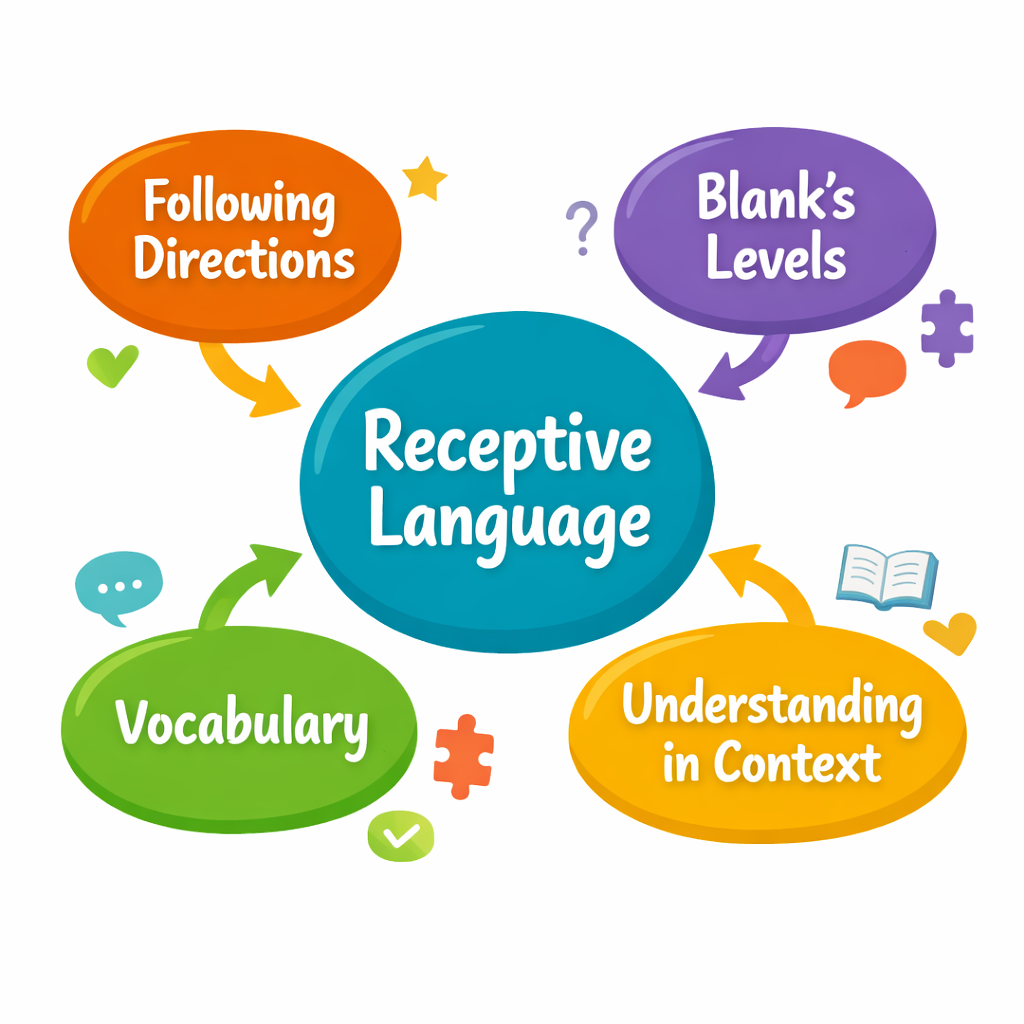
Receptive language is a child’s ability to understand spoken language. This includes understanding:
Words (e.g. “shoe,” “run,” “big”)
Instructions (e.g. “put your coat on”)
Questions (e.g. “where is your bag?”)
Conversation and meaning in context
It is how children make sense of the language they hear around them.
Receptive language develops before expressive language (what a child says). This means a child will usually understand more than they can communicate.
What does receptive language look like in everyday life?
A child with well-developed receptive language will:
Follow instructions appropriate for their age
Respond to questions
Understand routines and expectations
Engage in conversations
A child with receptive language difficulties might:
Seem like they are not listening
Need instructions repeated or simplified
Follow only part of an instruction
Watch others to work out what to do
Struggle more in busy or language-heavy environments
These difficulties are often mistaken for inattention or behaviour, when the underlying issue is understanding.
Why receptive language matters
Receptive language underpins:
Learning in the classroom
Social interaction
Emotional understanding
Independence in daily routines
If a child cannot fully access language, it affects far more than communication.
Key ways receptive language is assessed
1. Following Instructions and Information Carrying Words (ICWs)
Following instructions is one of the most functional ways to assess receptive language, and this is closely linked to Information Carrying Words (ICWs).
ICWs refer to the number of key pieces of information a child must understand within a sentence.
For example:
“Sit down” → 1 key idea
“Give the ball to the teddy” → object + recipient
“Give the small cup to the doll” → size + object + recipient
Typical development (guideline ranges)
(Approximate ranges based on commonly used clinical frameworks such as Shipley & McAfee and early language development guidance)
By 12–18 months: understands 1 ICW in familiar contexts
By 2 years: understands 1–2 ICWs
By 2.5–3 years: understands 2 ICWs consistently
By 3–4 years: understands 2–3 ICWs
By 4–5 years: understands 3–4 ICWs
By 5+ years: able to manage multiple ICWs within longer instructions
What this tells us
This helps identify:
How much language a child can process at once
Whether they rely on context rather than understanding
Why they may struggle as language becomes more complex
2. Blank’s Levels of Questioning
Blank’s Levels describe how a child understands different types of language, progressing from concrete to abstract.
Level 1: Naming and identifying
“What is this?”
“Find the car”
Level 2: Describing and recalling
“What is happening?”
“Find something you wear”
Level 3: Reasoning and linking ideas
“What will happen next?”
“Which one is different?”
Level 4: Abstract thinking and inference
“Why did that happen?”
“How do you know?”
Typical development (guideline ranges)
(Adapted from Blank, Rose & Berlin and widely used clinical interpretations)
Around 2–3 years: secure at Level 1
Around 3–4 years: developing Level 2
Around 4–5 years: developing Level 3
Around 5–7 years: developing Level 4
What this tells us
This helps identify:
The level of language a child can understand
Whether they can move beyond what they see to reasoning and inference
Why certain question types may be challenging
3. Understanding of Vocabulary
A child’s understanding of individual words is a core part of receptive language.
This includes:
Objects (e.g. “shoe,” “cup”)
Actions (e.g. “running,” “cutting”)
Describing words (e.g. “big,” “empty,” “fast”)
Typical development (guideline ranges)
(From developmental language research such as Fenson et al.)
By 12 months: understands familiar words (e.g. own name, “no”)
By 18 months: understands a range of everyday words and simple instructions
By 2 years: understands approximately 200–500 words
By 3 years: understands 500–1000+ words
By 4–5 years: understands several thousand words, including basic concepts
What this tells us
Difficulties here can affect:
Following instructions
Understanding new information
Social communication
4. Understanding in real-life contexts
Structured tasks do not always reflect how a child understands language in everyday situations.
Observation is used to assess:
How a child responds in conversation
Whether they follow group instructions
How they cope in busy environments
Typical expectations
Early years: follows simple instructions within routines
Primary school age: follows group instructions and classroom language
Later primary: understands more complex, less contextualised language
What this tells us
Some children:
Cope well one-to-one but struggle in groups
Understand when language is slowed down, but not at natural pace
Important note on age ranges
All age ranges are approximate guidelines, not fixed rules. Children develop at different rates, and receptive language skills are not always evenly developed.
Assessment focuses on identifying patterns and areas of need, rather than comparing a child to a single age expectation.
Putting it all together
Receptive language assessment combines:
Following instructions and ICWs
Blank’s Levels
Vocabulary understanding
Real-world observation
This allows a clear understanding of:
What the child understands
Where breakdowns occur
How to adapt communication effectively
Final thought
Receptive language is about how a child makes sense of the language around them.
When this is understood, support can be targeted and practical, helping children access learning, interaction, and everyday life more effectively.
If you have concerns about your child’s understanding, or you have noticed they are struggling to follow instructions, respond to questions, or keep up in everyday situations, seeking advice early can make a meaningful difference.
You can get in touch here to discuss your concerns or book an assessment.